Drone Survey
Building and roof survey
One building photographed from the air in detail, ridge to gutters, and written up so the condition of the parts nobody can reach is on the record.
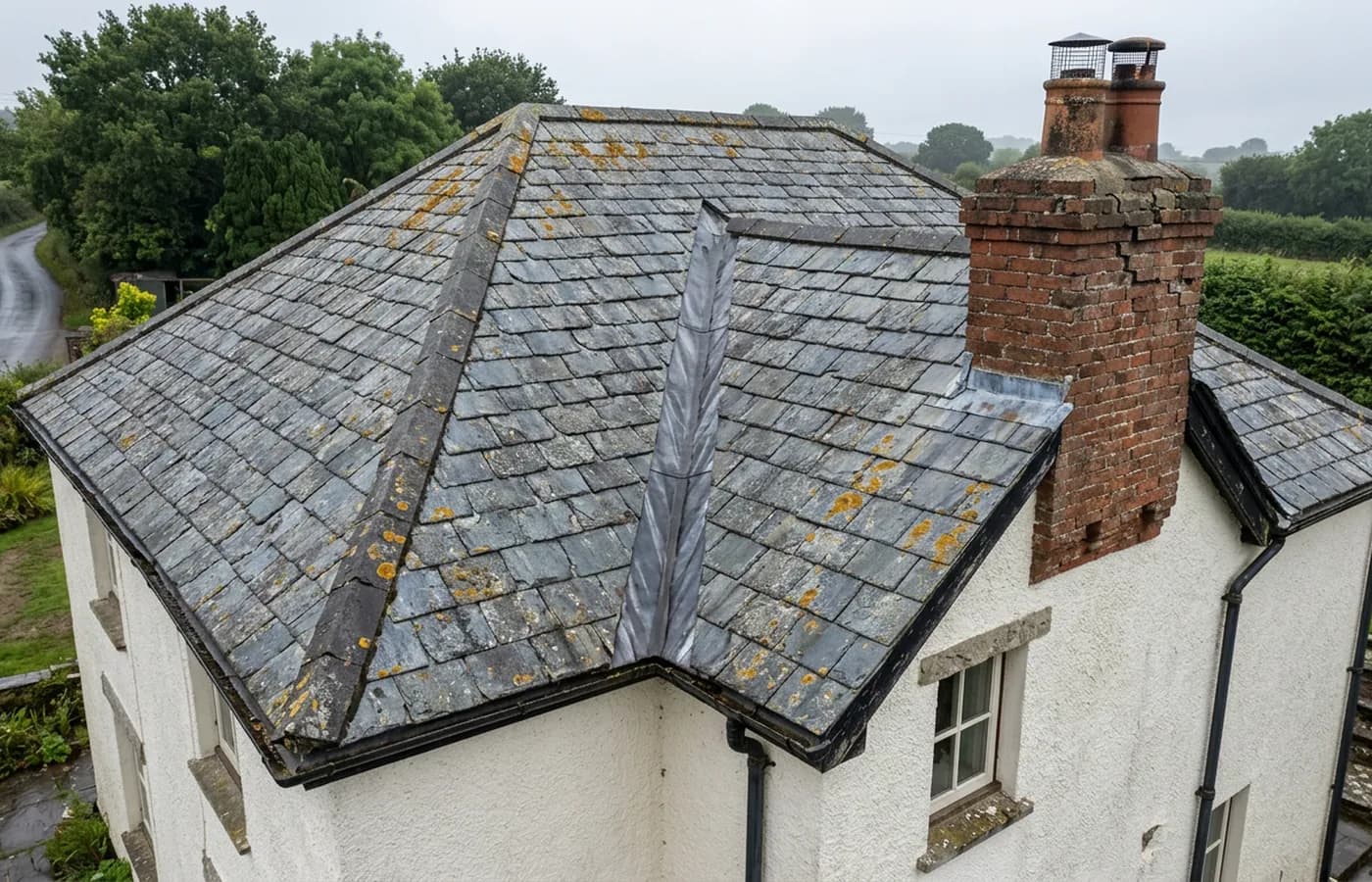
This is the one most people mean. A house, a block of flats, a church, a barn, a commercial unit: anything with a roof and elevations that are awkward to look at from the ground. The aircraft works round the building at a few set heights, photographing each face and then the roof itself, and comes down again.
The point of it is reach rather than resolution alone. A roof is the part of a building that fails first and is looked at least, because looking at it properly has always meant a scaffold, a tower, a long ladder or somebody accepting a risk. That cost is why most roofs are only inspected after something has already gone wrong inside.
What you are left with is a dated set of photographs of the condition of the outside, and a written note of what they show. Not a diagnosis of what is happening in the loft, and not a price for putting anything right. A record, in enough detail that the next person can quote from it.
What is included
- Every elevation photographed at first floor and roof height
- The roof plan photographed from above, pitch by pitch
- Close detail on ridges, valleys, flashings, verges and chimney stacks
- Gutters, downpipes and outlets, including where water is standing
- Any specific worry you point out, covered deliberately rather than by luck
- A captioned report inside 48 hours plus the original image files
What this finds, and what it does not
It finds things on the surface. Slipped, cracked and missing slates or tiles. Mortar that has washed out of a ridge or a verge. Lead that has lifted or split. Moss holding water in the laps. Blocked gutters and outlets, and the staining that shows where water has been going instead. Cracked render, failed pointing, and vegetation growing where it should not be.
It does not find what is under the covering. Rotten battens, a failed underlay, a leak that runs along a rafter before it appears three metres away, damp inside a wall: none of that is visible from the air and no photograph will settle it. Where the images suggest something like that, the report says the images suggest it, and says what would actually confirm it.
That distinction matters more on this job than on any other, because a roof photograph looks so convincing. A survey that overclaims is worse than no survey, since somebody will spend money on the strength of it.
Why people usually book one
The most common reason is a quote that cannot be checked. Somebody has been up a ladder, come down and described a problem, and the price attached to it is large. A set of photographs turns that into something two other roofers can price against without each one needing their own access.
The second most common is a sale. A buyer's survey has flagged the roof, the sale has stalled, and somebody needs to know how serious it is before either side moves. A dated photographic record is usually enough to unstick it in one direction or the other.
After that it is insurance claims, managing agents who need a condition record for a building they do not live in, and people who simply want to know what state the roof is in before they spend money elsewhere on the house.
What the building needs to be like on the day
Occupied is fine. Cars on the drive are fine. Nobody needs to move out, move anything or be anywhere in particular except available to open a gate. The one thing that really helps is somebody being on site who knows the building.
Take off and landing needs a few square metres of clear ground with nothing overhead: a lawn, a drive, a yard, a field gateway. On a terrace with no garden that can mean working from the street or from a neighbour's ground, which is worth mentioning when you first get in touch.
On the day
How a building and roof runs
- Step 1
Walk the outside
Five minutes on foot first, to see what you are worried about and where the aircraft can safely work from. This is also where you say what the report needs to prove.
- Step 2
Fly the elevations
Each face of the building in turn at two heights, so windows, render, pointing and rainwater goods are all covered before the roof is started.
- Step 3
Fly the roof
An overhead pass for the plan, then closer work along ridges, valleys, abutments and around every stack and rooflight.
- Step 4
Sort, caption and send
The useful frames are picked out, matched to the part of the building they show, captioned and written up. With you inside 48 hours.
Behind the work
Kit, cover and qualifications
CAA registered
Registered with the Civil Aviation Authority as an operator, with both an Operator ID and a Flyer ID held. Anybody flying a camera drone for you should hold both.
A2 Certificate of Competency
The qualification that covers flying closer to buildings and to people than the basic rules allow. It is not a GVC and this site does not claim one.
Insured with Coverdrone
Commercial flights are covered by a Coverdrone policy. A copy of the certificate is available on request, and most managing agents will ask for it.
One named surveyor
Sam Hembury plans and flies every job himself and writes up every report. There is no crew and no subcontractor, so the person you speak to is the person who turns up.
DJI Mavic 4 Pro
A 100 megapixel Hasselblad camera and 6K video. That resolution is the reason a cracked mortar joint is readable in a photograph taken from twenty metres away.
DJI Mavic 2 Enterprise Advanced
Carries a 640 by 512 radiometric thermal camera alongside the ordinary one, which is a different job: heat and moisture rather than condition.
Report within 48 hours
The written report follows the flight within 48 hours. It is a process commitment rather than a promise about what the report will find.
Construction background
The reports are written by somebody who worked in construction before flying, so a defect is described in the words a builder or a roofer will use back to you.
Building and roof
Building and roof survey questions
- Will it tell me whether the roof needs replacing?
- It will show you the condition of the covering and the detail work in photographs, and describe what is visible. Whether that adds up to a repair or a replacement is a judgement a roofer makes, and this survey is what they should be making it from.
- Can you see inside the loft?
- No. The aircraft photographs the outside only. If the question is about the structure underneath, somebody needs to be in the loft with a torch, and the survey cannot stand in for that.
- How close does the drone get to the building?
- Close enough that mortar joints are readable, and no closer than the rules and the conditions allow. The A2 Certificate of Competency covers working nearer to structures than the basic rules permit, which is what makes that detail possible.
- Do the neighbours need to be told?
- Not usually, though it is a courtesy on a terrace or a tight street. The camera is pointed at the building being surveyed rather than at anything around it, and the report contains only that building.
Where
Building and roof survey across the South West
Also on this site
See what it costs
Get a quote with Drone Survey
Tell us the address and what you need looking at. Sam Hembury will come back with a fixed price and the next available slot.