Devon · PL1-PL9
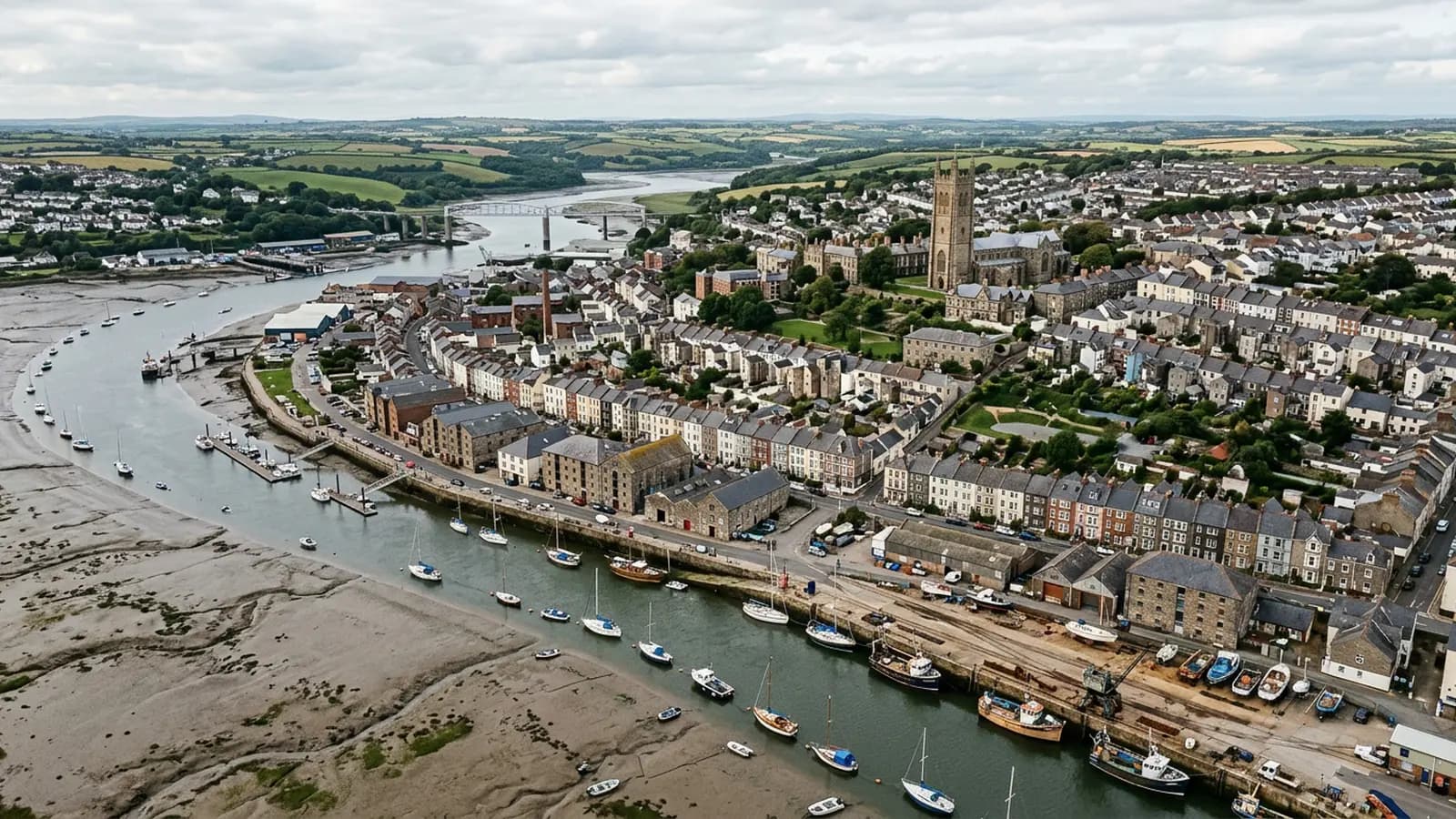
Drone survey in Plymouth
A hilly naval city of flat commercial roofs, surviving Victorian terraces and exposed post-war estates, where the wind comes straight off the Sound.
Three cities of roofs in one
Plymouth's stock splits into parts that have almost nothing in common. The rebuilt post-war centre is flat-roofed commercial blocks with asphalt and single ply coverings. The Hoe, Stoke and Mutley have surviving Victorian terraces under natural slate with lead and zinc on the civic buildings among them. The outer estates are post-war housing under concrete interlocking tile, and the waterfront at Royal William Yard and Millbay is modern apartments.
A survey question in one of those is not the same question as in another. Flat roofs fail by ponding, by movement at upstands and by outlets that stop working. Victorian slate fails at the valleys, the abutments and the chimney. Post-war estate roofs fail at the ridge and the verge. Knowing which of those you are dealing with is most of the value of the first conversation.
Limestone ridges and the gradient problem
The city is built over limestone ridges between the Plym and the Tamar, so streets climb and fall sharply between the waterfront and the higher suburbs. Plenty of properties sit on ground that is a metre or more above their neighbour, which makes ladder and tower access awkward and makes an accurate view of the roof from the street impossible.
It also affects where an aircraft can sensibly work from. On a sloping terrace the useful take off position is frequently not the property's own ground, and the flight is planned around the gradient rather than the address.
Weather off the Sound
Plymouth is open to the Sound and to south-westerly gales coming straight off the Channel. Salt-laden wind reaches well inland across the city rather than stopping at the front, and the exposed high suburbs at Crownhill and Southway catch the weather badly despite being nowhere near the water.
That combination is hard on the details rather than the fields of a roof. Ridge and hip fixings, verge pointing, the edge trim on a flat roof and the flashing at a parapet are where a storm season shows first, and every one of those is at the boundary of a roof where nobody can see it from below.
Blocks, flats and shared responsibility
A great deal of Plymouth housing is flats, which means a roof usually belongs to a freeholder or a management company rather than to the person who notices the leak. That changes what a survey is for: it becomes evidence in a conversation with somebody who has to be persuaded to spend money.
For that job a photographic record works better than a description, because it is difficult to argue with a dated image of standing water around an outlet. It is also worth having before a service charge dispute rather than during one.
The Barbican, Royal William Yard and the historic waterfront
Sutton Harbour, the Barbican and Royal William Yard hold some of the oldest and some of the newest buildings in the city, often within sight of each other. The historic waterfront has slate, lead and stone in tight streets, and the converted yard has large stone structures with modern roof coverings inside them.
For a PL1 address in either, the survey question is usually about the interface between old fabric and recent work. A modern covering laid inside a historic parapet, or a new rooflight in an old slope, is where the water tends to find its way in.
The dockyard and the working waterfront also mean flights on that side of the city are planned in advance rather than arranged for the next morning, which is worth building into any timetable.
Behind the survey
What Plymouth clients are actually buying
CAA registered
Registered with the Civil Aviation Authority as an operator, with both an Operator ID and a Flyer ID held. Anybody flying a camera drone for you should hold both.
A2 Certificate of Competency
The qualification that covers flying closer to buildings and to people than the basic rules allow. It is not a GVC and this site does not claim one.
Insured with Coverdrone
Commercial flights are covered by a Coverdrone policy. A copy of the certificate is available on request, and most managing agents will ask for it.
One named surveyor
Sam Hembury plans and flies every job himself and writes up every report. There is no crew and no subcontractor, so the person you speak to is the person who turns up.
DJI Mavic 4 Pro
A 100 megapixel Hasselblad camera and 6K video. That resolution is the reason a cracked mortar joint is readable in a photograph taken from twenty metres away.
DJI Mavic 2 Enterprise Advanced
Carries a 640 by 512 radiometric thermal camera alongside the ordinary one, which is a different job: heat and moisture rather than condition.
Report within 48 hours
The written report follows the flight within 48 hours. It is a process commitment rather than a promise about what the report will find.
Construction background
The reports are written by somebody who worked in construction before flying, so a defect is described in the words a builder or a roofer will use back to you.
Nearby
Also covered around Plymouth
- SaltashNear-vertical waterside streets under two bridges, where the Tamar funnels wind hard and conventional access on the old town is awkward and costly.
- IvybridgeA late twentieth century commuter town on the southern moor edge, where estates from the 1970s onward have all reached the same maintenance age together.
- TavistockA planned Victorian town in green Hurdwick stone on the wet western edge of Dartmoor, with tall stone chimneys that take serious wind loading.
- KingsbridgeA steep estuary-head town where Fore Street climbs hard from the quay and the tightly packed roofs sit in each other's turbulence.
See what it costs
Get a quote in Plymouth
Send the address and what is worrying you. Sam Hembury will come back with a fixed price and the next slot that suits the weather.